Quick answer
Powerball works like this: for $2 per play you pick 5 white numbers from 1 to 69 and 1 red Powerball from 1 to 26 (or take a Quick Pick). Drawings are every Monday, Wednesday and Saturday at 10:59 p.m. Eastern. Match all six for the jackpot; 8 smaller prize levels pay from $4 up to $1 million. Optional add-ons are Power Play and, in some states, Double Play. This guide maps the whole game in 9 short sections; each one links to the Atlas Numbers article that covers it in depth.

The Atlas Numbers blog now has more than twenty lottery guides, and most of them answer one Powerball question at a time. This page puts them in order. Read it top to bottom in about nine minutes and you will understand the whole game, from buying a ticket to what happens if your numbers come up. Every section ends with the guide to read next.
1. The ticket: what you pick and what it costs
Each Powerball play costs $2. You choose 5 white numbers from 1 to 69 and 1 red Powerball from 1 to 26; the red ball is drawn from a separate drum, so the same number can appear in both. Powerball is sold in 45 states plus Washington, D.C., Puerto Rico and the U.S. Virgin Islands, at lottery retailers and, in some states, through the official state lottery app or website. You must be 18 or older in most states (older in a few).
Read next: How to play Powerball for the first time: ticket, draw night and claiming.
2. Choosing numbers: Quick Pick or your own
You can mark your own numbers or ask for a Quick Pick, where the terminal chooses at random. Both have exactly the same chance. The one thing your choice can affect is sharing: many people pick birthdays and anniversaries, which crowds numbers 1 to 31, so a winning ticket full of dates is more likely to be split. Spreading picks across the full range does not improve your odds, but it can reduce the chance of sharing a prize.
Read next: How to pick lottery numbers (and the birthday mistake), Quick Pick vs. your own numbers vs. an app and hot and overdue numbers explained.
3. When the drawings happen and the cutoff
Powerball is drawn every Monday, Wednesday and Saturday at 10:59 p.m. Eastern Time. Sales stop before the drawing, and the exact cutoff depends on your state, often one to two hours before. If you buy after the cutoff, your ticket is for the next drawing.
Read next: Powerball drawing days and time, with the calendar and what time the Powerball cutoff is, by state. Playing Mega Millions too? See Mega Millions drawing days.
4. The odds, in one table
| Question | Official answer |
|---|---|
| Jackpot odds | 1 in 292,201,338 per play |
| Odds of winning any prize | 1 in 24.87 per play |
| Most common prize | Powerball only, 1 in 38.32 ($4) |
| Where the big number comes from | C(69, 5) = 11,238,513 white-ball sets × 26 Powerballs |
Every combination is equally likely in every drawing, and past results do not change the next one.
Read next: Powerball odds: calculate them yourself, which lottery has the best odds and how to win the lottery: what you can and cannot control.
5. What each match pays
There are 9 ways to win. The smallest prizes come from the red ball: matching only the Powerball pays $4. Three white numbers pay $7, four white numbers pay $100, and all five white numbers pay $1 million. Adding the Powerball to each match moves you up the chart, all the way to the jackpot for 5 + Powerball.
Read next: the Powerball payout chart: what 1, 2, 3, 4 or 5 numbers pay and 10 Powerball facts most players don’t know.
6. Power Play and Double Play
Two optional add-ons cost $1 extra per play each. Power Play multiplies any non-jackpot prize in the main drawing by the multiplier drawn that night, and Match 5 always becomes $2 million. Double Play, offered in some jurisdictions, enters your same numbers into a second, separate drawing held after the main one, with its own prize chart and a $10 million top prize.
Read next: is Power Play worth it? and Powerball Double Play: payout chart, cost and how it works.
7. The jackpot: cash value vs. annuity
The jackpot on billboards is the annuity: 30 graduated payments over 29 years. A winner can instead take the cash value, a lump sum that is noticeably smaller than the advertised figure. The jackpot starts at a set minimum and grows with every drawing that has no jackpot winner.
Read next: Powerball cash value vs. annuity: what the advertised jackpot really means.
8. Checking, claiming and taxes
Check every ticket against the official results; small wins are easy to miss. Prizes are claimed under the rules of the state where you bought the ticket, and many lotteries give you about 180 days from the drawing (each state sets its own deadline). Larger prizes are taxable: for prizes over $5,000, 24% federal tax is withheld, and your actual federal rate can be higher, plus state tax where it applies.
Read next: how to check lottery numbers for free and lottery taxes: how much tax on Powerball winnings.
9. Pools, gifts and playing away from home
Powerball is often a group activity. Office and family pools work best with a simple written agreement and copies of every ticket. Tickets make popular stocking stuffers, but only for adults and with a few etiquette rules. And if you travel, you can buy a ticket in any participating state, as long as you claim it under that state’s rules.
Read next: how to start a lottery pool, lottery tickets as gifts and playing the lottery while traveling. Curious about other games? Try Mega Millions questions answered or scratch-off odds explained.
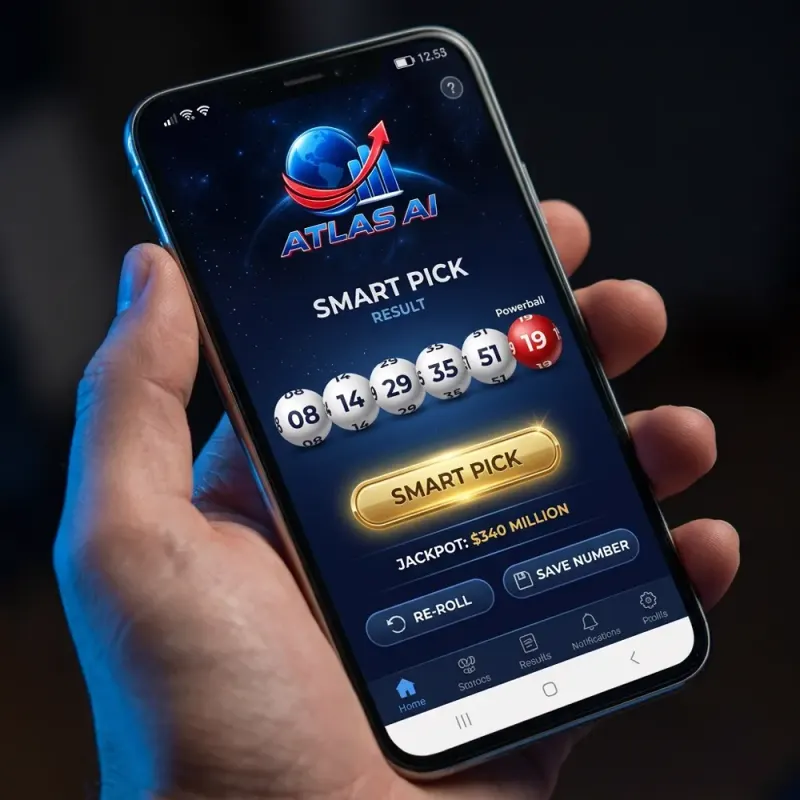
Our recommendation: Atlas AI
Now that you know how every part of Powerball fits together, the part you can actually improve is how organized your play is, and Atlas AI Lotto Money is the tool we recommend for that. It brings the pieces of this guide into one dashboard: build your combinations, check results and browse draw history without juggling apps, slips and websites. It never promises wins or better odds, because nothing can change them.
- Smart Pick: builds up to ten combinations in seconds across the full number ranges, using draw history since 1985, so you avoid crowded birthday-only picks.
- Results Panel: the latest Powerball and Mega Millions results in one place, so every ticket gets checked.
- Draw History: searchable past draws for anyone who likes to look at the numbers.
- Powerball Frequency Analyzer and Hot & Overdue Tracker: decades of draws turned into simple charts, for fun and curiosity.
- 4 bonus guides included with the purchase.
Atlas AI costs $197, one payment, with lifetime access and a 60-day money-back guarantee. It works on your phone or computer. It is a number-selection and tracking tool for entertainment: it cannot predict draws or change the odds. Read our full Atlas AI review before you decide.
FAQ
How does Powerball work, in simple terms?
You pay $2 per play and pick 5 white numbers from 1 to 69 plus 1 red Powerball from 1 to 26, or let the terminal choose with a Quick Pick. Drawings are held every Monday, Wednesday and Saturday at 10:59 p.m. Eastern. Match all six to win the jackpot; there are 8 smaller prize levels, down to $4 for matching only the red Powerball.
How many numbers do you need to win something in Powerball?
Matching just the red Powerball wins $4. Without the Powerball you need at least 3 white numbers ($7). Two white numbers alone win nothing, but two white numbers plus the Powerball win $7.
What are the odds of winning Powerball?
The jackpot odds are 1 in 292,201,338 per play, and the overall odds of winning any prize are 1 in 24.87, according to the official prize chart.
Where can you play Powerball?
Powerball is sold in 45 states plus Washington, D.C., Puerto Rico and the U.S. Virgin Islands. You must buy the ticket in a participating jurisdiction and claim the prize under that lottery’s rules.
What is the difference between Power Play and Double Play?
Both cost $1 extra per play. Power Play multiplies non-jackpot prizes in the main drawing (Match 5 always becomes $2 million). Double Play, offered in some jurisdictions, enters your same numbers into a second, separate drawing with a $10 million top prize.
Can an app or system make Powerball easier to win?
No. Every combination has the same chance in every drawing. A tool can make playing more organized, for example by building combinations across the full number range and keeping results in one place, but it cannot change the odds.
Sources (checked November 19, 2026): Powerball game rules, drawing schedule and prize chart (5 of 69 + 1 of 26, $2 per play, Monday/Wednesday/Saturday 10:59 p.m. ET, odds per tier and overall 1 in 24.87, Power Play and Double Play rules) as published by Powerball and participating state lotteries; IRS instructions for Form W-2G (24% federal withholding). Rules, cutoffs and claim deadlines vary by state; always confirm with your state lottery.
Play for fun, play within a budget
The lottery is entertainment, not a plan for money. Decide on a fixed budget before you buy and never play to win back losses. 18+ only (or the legal age in your state). Help is available 24/7 at 1-800-MY-RESET.
New here? Start at the Atlas Numbers home page.